


How strong are products made with rotational moulding?
I see rotational moulding products everywhere. I trust them for playground equipment, storage tanks, and traffic barriers. Their thick, seamless walls resist impact and harsh weather. Polyethylene gives strength and durability. Manufacturers add UV stabilizers and antioxidants for outdoor use. These products meet tough demands in industrial and everyday settings.
Key Takeaways
- Choosing the right material and adding UV stabilizers greatly improve the strength and durability of rotational moulded products, especially for outdoor use.
- Design features like uniform wall thickness, reinforcing ribs, and double walls boost product strength without adding too much weight or cost.
- Careful control of manufacturing steps and quality checks prevent weak spots, ensuring products last over 20 years in tough environments.
What Determines the Strength of Rotational Moulding Products?

Material Properties
When I look at the strength of products made with rotational moulding, I always start with the material. The type of plastic resin makes a big difference. Polyethylene is the most common choice because it balances strength, flexibility, and cost. I have seen other materials like polypropylene and nylon used for special needs. Each material brings its own set of properties. For example, high-density polyethylene (HDPE) gives more stiffness and strength, while low-density polyethylene (LDPE) offers better impact resistance.
Resin density matters a lot. Higher density resins make products stiffer and stronger. Lower density resins give more flexibility, which helps absorb impacts. The melt index of the resin also affects how the plastic flows during moulding. A higher melt index means the resin melts and moves more easily, but it can change the final strength of the product.
Tip: For outdoor products, I always check if the resin has UV stabilizers. These additives help the product last longer in sunlight.
Other important properties include chemical resistance, temperature resistance, and how much moisture the material absorbs. For example, nylon has great strength but can take in more water, which might affect its shape over time. Polypropylene stands out for higher stiffness and temperature resistance, but it is harder to mould.
Wall Thickness and Construction
Wall thickness plays a huge role in how strong a rotational moulding product will be. Thicker walls usually mean more strength and better impact resistance. However, I have learned that making walls too thick increases cost and production time. Most polyethylene parts have a wall thickness between 0.125 and 0.25 inches. This range gives a good balance between strength and efficiency.
| Product/Feature Type | Recommended Wall Thickness / Dimension Range | Additional Design Notes |
|---|---|---|
| Polyethylene (PE) applications | 0.125 to 0.25 inches nominal thickness | Tolerances around ±20%; thicker walls increase cost and production time |
| Reinforcing ribs | Height: 4x wall thickness; Width: 5x wall thickness | Rectangular ribs provide better stiffness; ribs should have draft/taper to avoid molding issues |
| Corner radii (minimum) | Inside: ≥ 1/8 inch; Outside: ≥ 3/16 inch | Larger radii needed for thicker walls; sharp corners weaken parts |
Sometimes, I use double-wall construction or add a foamed core to boost strength without making the product too heavy. Reinforcing elements like metallic mesh or foamed macro-spheres can bridge the inner and outer skins, making the product even stronger. I always make sure the gap between parallel walls is at least five times the wall thickness to avoid defects.
Design Features and Reinforcements
The design of a product can make it much stronger. I often add reinforcing ribs to thin-walled parts. These ribs increase stiffness without using a lot of extra material. I make sure the ribs are at least four times as tall as the wall thickness and five times as wide. Rectangular ribs give more stiffness, but rounded ribs are easier to mould.
Double-walled designs are easy to make with rotational moulding. They create seamless edges, which remove weak points and make the product more durable. I also notice that corners and edges come out thicker than with other moulding methods. This extra thickness helps prevent cracks and dents.
- Reinforcing ribs add stiffness and strength.
- Double walls and thicker corners boost durability.
- Multiple shallow ribs work better than one deep rib.
For special needs, I sometimes use advanced reinforcements. For example, adding carbon fiber tape to the surface can help the product resist cracking, even after many cycles of stress.
Manufacturing Quality
The way I control the manufacturing process affects the final strength of every product. I always check the oven temperature and rotation speed. If the temperature is too high or too low, the plastic might not fuse well, leading to weak spots. Proper rotation spreads the material evenly, so the walls stay the same thickness all around.
Quality control is key. I follow these steps to make sure every product meets high standards:
- I get certified resin from trusted suppliers.
- I measure the melt flow index to check how the resin will behave.
- I dry the resin to remove moisture, which can cause air pockets.
- I test small batches before full production.
- I store materials in the right conditions to keep them fresh.
I also inspect each product for surface finish, color, and size. I run mechanical tests for impact resistance and strength. If I find defects like air pockets or uneven walls, I know these can weaken the product. For example, air pockets create weak spots, and thin areas can warp or break more easily. I adjust the process to fix these problems right away.
Note: Regular mold maintenance and operator training help prevent defects and keep quality high.
Rotational Moulding Strength in Practice
.jpg)
Typical Strength Metrics and Performance
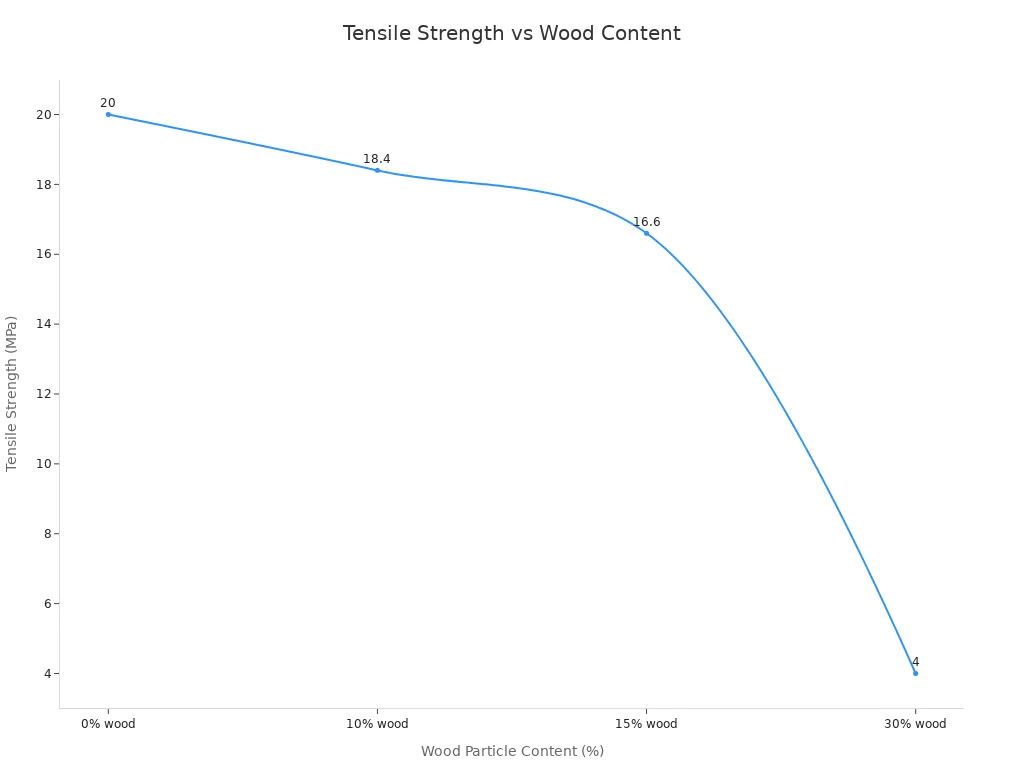
When I test products made with rotational moulding, I look at several key strength metrics. Tensile strength tells me how much force a product can handle before it stretches or breaks. For pure polyethylene products, I usually see tensile strength values around 20 MPa. If I add wood particles to the mix, the tensile strength drops. For example, with 10% wood content, the strength falls to about 18.4 MPa. At 30% wood, it drops sharply to just 4 MPa. The elastic modulus, which measures stiffness, can actually increase with some fillers, making the product less flexible but more rigid.
| Property | Condition/Composition | Typical Values / Observations |
|---|---|---|
| Tensile Strength | Neat recycled HDPE (0% wood) | ~20 MPa |
| Tensile Strength | 10% wood particle content | ~18.4 MPa |
| Tensile Strength | 15% wood particle content | ~16.6 MPa |
| Tensile Strength | 30% wood particle content | ~4 MPa |
| Elastic Modulus | Composite with wood particles | Up to 16% higher than neat HDPE |
I can also improve compression and impact strength by adding special fillers. For example, using TiO2–lignin composites in the plastic mix boosts compression and impact resistance. If I want even better performance, I add compatibilizers like MAPE. In ultra-high-filled wood fiber/polyethylene composites, this can increase tensile strength by over 26%.
I always pay attention to failure modes during stress testing. The most common problems include incomplete fusion, warping, pinholes, and inconsistent wall thickness. These issues can create weak spots and reduce overall strength. Residual stresses from uneven cooling or poor processing can also cause cracks and lower impact resistance.
Products made with rotational moulding often last over 20 years in heavy-duty applications. Their seamless construction and chemical resistance help them stand up to harsh environments.
Real-World Applications and Examples
I see rotational moulding used in many industries that demand high strength and durability. Some of the most common applications include:
- Aerospace: Fluid tanks, ducts, and fittings that need flame retardancy and chemical resistance.
- Agriculture: Sprayers, storage tanks, and containers that resist chemicals and UV light.
- Automotive: Ducting, bottles, and cylinders that require impact resistance and tight tolerances.
- Mining and Metallurgy: Chemical-resistant tanks and vessels for harsh environments.
- Pharmaceuticals and Semiconductors: High-purity containers and bottles that meet strict standards.
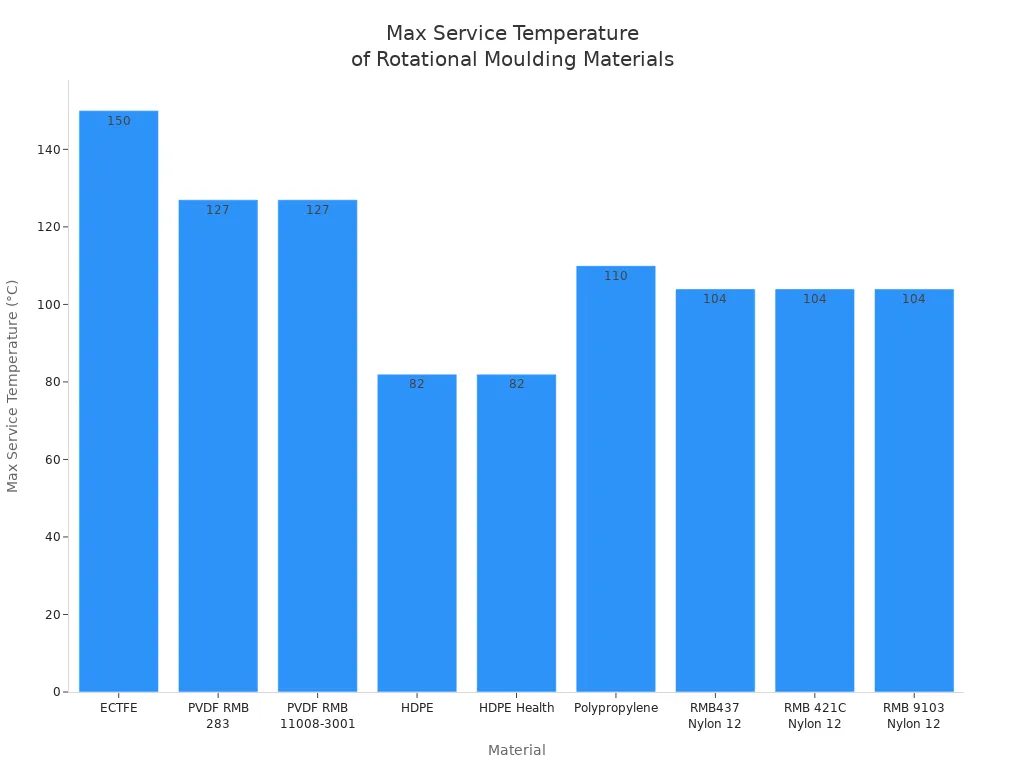
These products must have seamless interiors, uniform wall thickness, and excellent resistance to chemicals and weather. I often choose specialized polymer resins like PVDF, Nylon 12, and HDPE for these applications. Each material offers unique benefits, such as high service temperatures or flame retardancy.
| Material | Application Description | Max Service Temperature |
|---|---|---|
| ECTFE | Chemical-resistant molded tanks, vessels, and bottles. | 302°F / 150°C |
| PVDF RMB 283 | Aerospace and semiconductor fluid tanks, ducts, and fittings; flame retardant; FDA compliant. | 260°F / 127°C |
| HDPE | Chemical resistance, UV stabilized, high stiffness. | 180°F / 82°C |
| Polypropylene | Impact-resistant copolymer with good chemical resistance. | 230°F / 110°C |
| RMB437 Nylon 12 | High impact, flame retardant resin for aerospace ECS ducting. | 220°F / 104°C |
I have seen cross-linked polyethylene (XLPE) tanks perform well in extreme temperatures. XLPE resists rupture and deformation better than linear polyethylene, making it ideal for fuel tanks and vehicle duct systems. Advanced robotic rotational moulding technology lets me control heating and cooling zones precisely, which improves strength and repeatability.
Products made with rotational moulding resist UV rays, chemicals, and moisture. Their seamless construction prevents weak points, helping them last for decades.
Load and Impact Resistance Compared to Other Methods
I often compare rotational moulding to other plastic manufacturing methods. One big advantage is the way the process coats the mold evenly. This creates a uniform shell without internal stress points. Injection moulded products can develop weak spots that break under pressure. Rotational moulding avoids these problems, giving products better fatigue life and durability.
Blow moulded products are lighter and thinner, but they do not match the strength and impact resistance of rotational moulded parts. The thicker walls and seamless edges help absorb shocks and prevent cracks. I have found that rotational moulding produces stronger and more robust products, especially for heavy-duty and outdoor use.
Temperature extremes can challenge any plastic product. I choose heat-resistant materials like Polybenzimidazole (PBI) and Hostaform POM RF for demanding applications. These materials keep their strength even in harsh conditions. Robotic technology helps me layer different compounds, improving the strength-to-weight ratio and durability.
Rotational moulding products stand out for their long-term strength, impact resistance, and ability to handle tough environments. Their typical lifespan in heavy-duty use exceeds 20 years.
I trust rotational moulding for strong, durable products in tough jobs. I choose the right material, add ribs, and keep walls uniform for best results.
| Design Element | Key Optimization for Strength and Durability |
|---|---|
| Wall Thickness | Uniform (3-5 mm) |
| Ribs and Bosses | Increase strength by up to 30% |
| Material Selection | UV-resistant, durable materials |
New polymers and smart molding boost strength. Regular maintenance keeps products reliable for years.
FAQ
How long do rotational moulded products last?
I often see these products last over 20 years. Their seamless design and UV resistance help them survive tough outdoor conditions.
Can I recycle rotational moulded plastics?
Yes, I can recycle most rotational moulded plastics like polyethylene. I check local recycling rules before disposal.
Are rotational moulded products safe for food storage?
- I use food-grade resins for containers.
- These products meet FDA standards.
- I trust them for safe food and water storage.